 info@saintgloble.com
 (+91) 75758 08714
How to Choose the Best Tile Adhesive in India for Different Types of Tiles
Choosing the right tile adhesive is essential for achieving strong bonding, durable installation, and a professional finish. Whether you are installing ceramic tiles in a bathroom, vitrified tiles in a living room, or decorative tiles in a commercial space, selecting the appropriate adhesive can significantly affect the quality and longevity of your project.
In India, the demand for tile adhesives continues to grow with residential construction, commercial development, and renovation projects. Homeowners, builders, architects, and tile installation professionals need to consider tile material, surface conditions, application requirements, and product specifications before selecting an adhesive.
Saint Globle offers a range of tile adhesive products for different construction and tiling requirements. From grey and white adhesive options to specialised products within its adhesive portfolio, the company provides solutions that customers can explore according to their project needs.
In this guide, we will explain how to choose the best tile adhesive in India for different types of tiles, the factors to consider before purchasing, common installation mistakes, and the tile adhesive products available from Saint Globle.
What Is Tile Adhesive?
Tile adhesive is a specially formulated bonding material used to fix tiles to suitable surfaces, including walls and floors. Depending on its formulation, it may contain cement, graded aggregates, polymers, and other additives designed to provide the required bonding properties and workability.
Tile adhesives are widely used in residential, commercial, and industrial construction projects. When selected and applied correctly, a suitable adhesive can help improve tile bonding and support a durable installation.
Common applications include:
- Ceramic and vitrified tile installation
- Porcelain tile installation
- Wall and floor tiling
- Bathroom and kitchen tiling
- Decorative tile and stone installation, where compatible
- Residential and commercial construction
- Renovation and repair projects
The right adhesive depends on the tile material, tile size, substrate, environmental conditions, and manufacturer's recommendations.
Why Is Choosing the Right Tile Adhesive Important?
Selecting the appropriate tile adhesive is an important step in achieving a reliable tile installation. Different tiles have different bonding requirements, so using an unsuitable product may result in poor adhesion, hollow-sounding tiles, or tile detachment.
Here are some key benefits of choosing the right tile adhesive.
1. Strong and Reliable Bonding
A suitable tile adhesive helps create a bond between the tile and the prepared surface. Its effectiveness depends on the product formulation, substrate condition, and correct installation.
2. Better Installation Quality
The right adhesive provides suitable workability, helping installers position and align tiles according to the required layout.
3. Reduced Risk of Tile Detachment
Using a compatible adhesive with proper surface preparation and adequate coverage can reduce the risk of loose or detached tiles.
4. Suitable for Different Tile Types
Different adhesive products are designed for different tile materials and installation conditions. Selecting the appropriate formulation helps meet the requirements of the project.
5. Improved Construction Efficiency
A suitable adhesive can make the installation process more manageable and help reduce avoidable repair work caused by incorrect product selection or application.
Different Types of Tiles and How to Choose the Right Adhesive
Before buying tile adhesive, identify the type of tile you plan to install. Ceramic, vitrified, porcelain, and natural stone tiles have different characteristics that influence adhesive selection.
1. Ceramic Tiles
Ceramic tiles are commonly used in homes, bathrooms, kitchens, and other interior spaces. They are available in a variety of colours, designs, and finishes.
When choosing tile adhesive for ceramic tiles, consider the tile dimensions, installation surface, and whether the tiles will be installed on walls or floors.
A suitable cement-based adhesive may be appropriate for conventional ceramic tiles when the product specifications permit the intended application.
2. Vitrified Tiles
Vitrified tiles are popular for residential and commercial flooring because of their dense structure and low water absorption.
Their low porosity makes it important to choose an adhesive specifically suitable for vitrified tiles. Consider the tile size, substrate condition, expected traffic, and installation environment before selecting a product.
For large-format vitrified tiles, verify that the adhesive is suitable for the dimensions and installation conditions involved.
3. Porcelain Tiles
Porcelain tiles are dense and have low water absorption. They are used in modern homes, offices, retail spaces, and other buildings.
When choosing adhesive for porcelain tiles, check the manufacturer's technical data sheet to confirm compatibility with the tile, substrate, and application.
4. Natural Stone Tiles
Natural stone materials, including marble and granite, are used for flooring, walls, decorative features, and other architectural applications.
Not every adhesive is suitable for every natural stone. Certain stones may be sensitive to moisture or susceptible to staining and discolouration.
Consider the stone type, colour, weight, moisture sensitivity, and installation location before selecting an adhesive.
5. Wall Tiles
Wall installations require an adhesive suitable for vertical applications and the weight of the selected tiles.
For larger or heavier tiles, check whether the product offers the required performance characteristics and suitability for the installation method.
6. Floor Tiles
Floor tile adhesives should be suitable for the tile material, prepared substrate, and expected loading conditions.
For commercial floors and high-traffic areas, carefully review the product specifications to ensure that the adhesive meets the project's requirements.
7. Outdoor Tiles
Outdoor tiles may be exposed to rain, temperature changes, sunlight, and moisture.
For balconies, terraces, exterior walls, and walkways, choose an adhesive specifically suitable for the intended exposure conditions. Where necessary, incorporate a properly designed waterproofing and drainage system.
Tile adhesive alone should not be treated as a replacement for waterproofing.
How to Choose the Best Tile Adhesive in India
Finding the best tile adhesive in India involves more than comparing prices or selecting a familiar product name. The adhesive must be compatible with the tiles and the installation conditions.
1. Identify Your Tile Type
Determine whether you are installing ceramic, vitrified, porcelain, or natural stone tiles.
Check the product information to confirm that the adhesive is recommended for the selected material.
2. Consider Tile Size and Weight
Large-format and heavy tiles may require adhesives with specific performance characteristics.
Consider the tile dimensions, weight, substrate flatness, and recommended application method before purchasing.
3. Check the Surface Condition
The installation surface should be sound, clean, and suitable for tiling.
Remove dust, oil, grease, loose material, and other contaminants. Repair weak areas and correct surface irregularities as necessary before applying the adhesive.
4. Understand the Application Environment
A bathroom wall, outdoor terrace, commercial floor, and interior living room may require different adhesive properties.
Check the product's suitability for moisture exposure, temperature conditions, and the intended application.
5. Review Technical Specifications
Before purchasing, check the adhesive's technical data sheet for:
- Recommended tile types
- Compatible substrates
- Mixing instructions
- Open time and working time
- Application thickness
- Coverage guidance
- Setting and curing requirements
- Indoor and outdoor suitability
6. Compare Price and Quality
Tile adhesive prices in India vary according to formulation, packaging size, performance characteristics, brand, and supplier.
Rather than choosing only by price, compare product suitability, recommended consumption, technical specifications, and the potential cost of installation repairs.
For current pricing and availability, contact the supplier directly.
7. Choose a Reliable Manufacturer
A reliable construction chemical manufacturer should provide relevant product information and guidance on selecting and using its products.
Saint Globle offers a range of tile adhesive products that customers can explore according to their construction requirements.
Explore Tile Adhesive Products from Saint Globle
Saint Globle offers a range of tile adhesive products for customers looking for suitable solutions for different tiling projects. The available range includes grey adhesives, white adhesives, and other adhesive products.
The following products can be explored through their official product pages. Always confirm each product's intended application and technical specifications before use.
1. SG Silver Grey Adhesive
SG Silver Grey Adhesive is part of Saint Globle's tile adhesive range.
Review the product specifications to determine its suitability for your tile type, substrate, and installation requirements.
2. SG Gold Grey Adhesive
SG Gold Grey Adhesive is another option in Saint Globle's adhesive portfolio.
Consult the official product information for details about recommended applications and compatibility.
3. SG Platinum Grey Adhesive
SG Platinum Grey Adhesive is available for customers exploring Saint Globle's grey tile adhesive options.
Check the manufacturer's technical guidance before selecting it for a specific tile installation.
4. SG Platinum Plus Adhesive
SG Platinum Plus Adhesive is part of the Saint Globle tile adhesive range.
Review its technical specifications and recommended uses to determine whether it meets your project's requirements.
5. SG Platinum Advance Adhesive
SG Platinum Advance Adhesive provides another option to consider when comparing Saint Globle's adhesive products.
Check the product documentation for tile compatibility, substrate requirements, and application recommendations.
6. SG G.M.A White Adhesive
SG G.M.A White Adhesive is one of the white adhesive products available from Saint Globle.
White formulations may be suitable for certain light-coloured or decorative materials, provided the product is compatible with the tile and intended application.
7. SG Unlimited Grey Adhesive
SG Unlimited Grey Adhesive is included in Saint Globle's adhesive portfolio.
Refer to the official product information to understand its intended use and suitability for your installation.
8. SG Unlimited White Adhesive
SG Unlimited White Adhesive is another white adhesive option from Saint Globle.
Review its technical details when choosing a product for decorative tiles or other applications where a white formulation may be appropriate.
9. SG Globaflex
SG Globaflex is another product in Saint Globle's range.
Explore the official product page for information about its intended application, product characteristics, and recommended installation practices.
10. SG Bond
SG Bond is part of Saint Globle's construction product portfolio.
Consult its official documentation to understand its intended use and determine whether it meets your project's bonding requirements.
11. SG Multi Gel Adhesive
SG Multi Gel Adhesive is another product available from Saint Globle.
Review its product specifications and application recommendations to determine its suitability for your tile and substrate.
Explore the Complete Saint Globle Tile Adhesive Range
To compare the available options, visit the official Saint Globle Tile Adhesive page.
Exploring the product range can help homeowners, contractors, builders, and tile installers identify a product that meets their project requirements.
Before purchasing, confirm the recommended tile types, application conditions, coverage, mixing instructions, and curing requirements with the manufacturer.
Step-by-Step Guide to Applying Tile Adhesive
Correct application is just as important as choosing the right product. Follow the manufacturer's instructions throughout the installation process.
Step 1: Prepare the Surface
Clean the surface and remove dust, oil, loose particles, and other contaminants. Repair damaged areas and ensure the substrate is suitable for the selected adhesive.
Step 2: Mix the Adhesive Correctly
For powder-based cementitious adhesives, measure the recommended amount of clean water and mix according to the product instructions.
Avoid adding excess water or attempting to retemper adhesive that has already started setting.
Step 3: Apply the Adhesive
Spread the adhesive using a suitable notched trowel. Select the trowel size according to the tile dimensions, substrate, and manufacturer's recommendations.
Apply only as much adhesive as can be covered within its specified open time.
Step 4: Position the Tiles
Place the tiles onto the adhesive and press them into position. Adjust alignment while the adhesive remains workable.
For certain large-format tiles, back-buttering may be recommended to help achieve adequate adhesive coverage.
Step 5: Check Adhesive Coverage
Periodically lift a tile to inspect the adhesive transfer and coverage.
Avoid excessive voids beneath tiles, especially in wet areas or locations subject to heavy use.
Step 6: Allow Proper Curing
Allow the adhesive to set and cure according to the manufacturer's instructions before grouting or permitting foot traffic.
Step 7: Apply Suitable Grout
Once the adhesive has reached the appropriate stage, fill the tile joints with a compatible grout or joint filler.
Use the correct joint treatment for the application, and preserve movement joints wherever required.
Common Tile Adhesive Mistakes to Avoid
Avoiding common installation errors can help improve tile bonding and reduce unnecessary repair costs.
- Choosing the wrong adhesive: Always check compatibility with the tile and substrate.
- Skipping surface preparation: Dust and loose material can interfere with bonding.
- Incorrect mixing: Follow the specified water ratio and mixing procedure.
- Exceeding open time: Adhesive that has formed a surface skin may not bond properly.
- Insufficient coverage: Inadequate adhesive coverage can leave unsupported areas.
- Ignoring curing time: Premature grouting or foot traffic can affect the installation.
- Choosing by price alone: The cheapest option may not meet the project's requirements.
- Ignoring waterproofing: Tile adhesive and grout do not automatically create a waterproof system.
Tile Adhesive vs Traditional Cement Mortar
Tile adhesive and traditional cement-sand mortar serve different purposes and are not interchangeable in every installation.
Tile adhesives are formulated for specific tile-bonding applications and can provide controlled workability and bonding characteristics. Traditional mortar may be suitable for certain applications, depending on the tile, substrate, and installation method.
When comparing the two, consider:
- Tile material and water absorption
- Tile dimensions and weight
- Substrate condition
- Required bonding performance
- Application thickness
- Environmental exposure
- Product specifications and overall installation cost
For dense vitrified or porcelain tiles, a compatible tile adhesive may be more appropriate than conventional mortar. Follow the tile manufacturer's recommendations and applicable installation standards.
Why Choose Saint Globle for Tile Adhesive Products?
Selecting the right construction chemical manufacturer can help simplify product selection and provide access to relevant technical information.
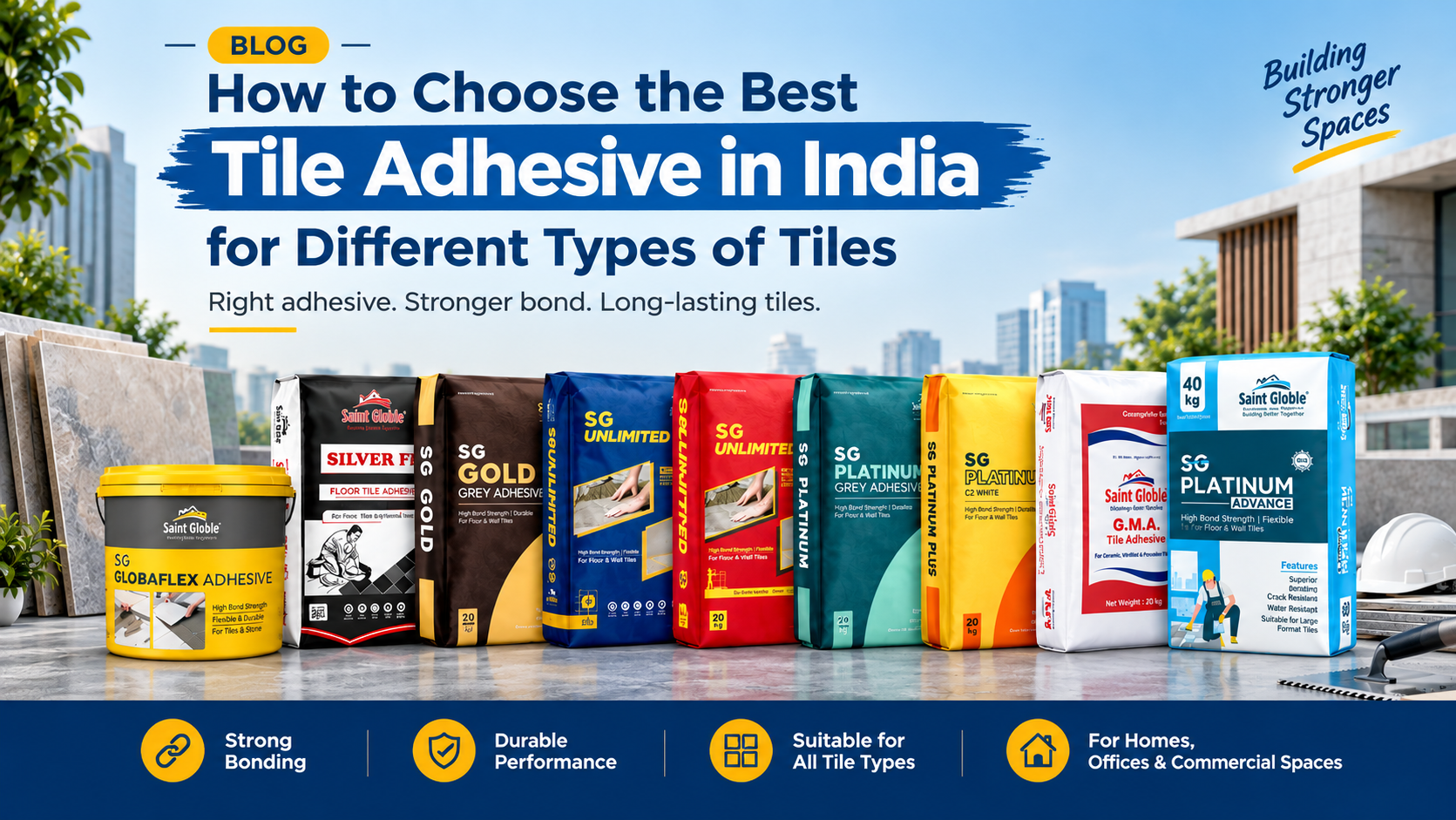
Saint Globle offers a range of tile adhesive products, including SG Silver Grey Adhesive, SG Gold Grey Adhesive, SG Platinum Grey Adhesive, SG Platinum Plus Adhesive, SG Platinum Advance Adhesive, SG G.M.A White Adhesive, SG Unlimited Grey Adhesive, SG Unlimited White Adhesive, SG Globaflex, SG Bond, and SG Multi Gel Adhesive.
When choosing a product, identify your tile type, installation surface, and project conditions before comparing the available options.
For the most appropriate selection, review the manufacturer's technical specifications and request product guidance when necessary.
Visit Saint Globle to explore its construction chemical products and enquire about suitable tile adhesive solutions.
Frequently Asked Questions About Tile Adhesive
1. Which Is the Best Tile Adhesive in India?
The best tile adhesive depends on the tile material, substrate, installation environment, and project requirements. Select a product whose technical specifications match the intended application.
2. Which Tile Adhesive Is Suitable for Vitrified Tiles?
Vitrified tiles generally require an adhesive suitable for their low water absorption. Check that the selected product is approved for vitrified tiles and the intended wall or floor application.
3. Can Tile Adhesive Be Used for Wall Tiles?
Yes, provided the adhesive is suitable for vertical applications and the tile's dimensions and weight. Follow the manufacturer's installation recommendations.
4. What Is the Difference Between White and Grey Tile Adhesive?
The main visible difference is the colour of the formulation. White adhesive may be relevant for certain light-coloured or decorative materials, but suitability and performance must be confirmed from the product specifications.
5. What Is the Price of Tile Adhesive in India?
Tile adhesive prices vary by formulation, packaging, performance characteristics, and supplier. Contact Saint Globle for current product pricing and availability.
6. Can Tile Adhesive Be Used for Natural Stone?
Some adhesives are suitable for natural stone, but compatibility varies. Consider moisture sensitivity, staining risk, stone weight, and the manufacturer's recommendations.
7. How Long Does Tile Adhesive Take to Dry?
Setting and curing times depend on the formulation, substrate, tile type, temperature, humidity, and application thickness. Follow the product's technical data sheet before grouting or allowing foot traffic.
8. Can Tile Adhesive Be Used in Bathrooms?
Yes, if the product is suitable for the tile and bathroom application. Areas requiring waterproofing should have a properly designed waterproofing system in addition to compatible adhesive and grout.
9. Where Can I Find Saint Globle Tile Adhesive Products?
Visit the Saint Globle Tile Adhesive page to explore the available products and access individual product pages.
10. How Do I Select the Right Saint Globle Tile Adhesive?
Identify the tile material, tile size, substrate, and installation conditions. Then review the relevant Saint Globle product specifications or contact the company for product guidance.
Conclusion
Choosing the best tile adhesive in India requires careful consideration of tile material, surface conditions, tile dimensions, moisture exposure, and the adhesive's technical specifications.
Whether you are installing ceramic tiles, vitrified tiles, porcelain tiles, or natural stone, selecting a compatible adhesive and following the correct installation process can help achieve a reliable, long-lasting result.
Saint Globle offers a diverse range of tile adhesive products, including grey and white adhesive options and other products within its adhesive portfolio. Exploring the available range and reviewing product specifications can help you make an informed decision for your next construction or renovation project.
Looking for a suitable tile adhesive for your project? Visit Saint Globle to explore the product range and enquire about product specifications, pricing, and application guidance.